
What a proper first visit looks like
Picture a washer supply hose that lets go on a Saturday afternoon. By the time anyone notices, the laundry room floor is wet, the hallway carpet is soaked and the drywall is wicking water upward. The crew you call should treat that first visit as an investigation, not a delivery of fans.
Expect the sequence below. If a company skips straight to setting equipment, that is your first sign the job will be guesswork. Our water damage cleanup work follows the same order for the same reason.
Find and stop the source
The crew confirms the water is off or the leak is isolated. Drying a room that is still being fed is pointless.
Classify the water
Clean supply water, gray water and sewage are handled very differently. S500 calls these categories 1, 2 and 3, and the category changes what can be dried and what must be removed.
Map the wet area
Meters and a thermal imaging camera show where moisture traveled, which is often well past the visible stain.
Explain scope and price
You should hear what comes out, what stays, what equipment goes in and how it will be priced, all before work starts.
Equipment you should expect, and what it does
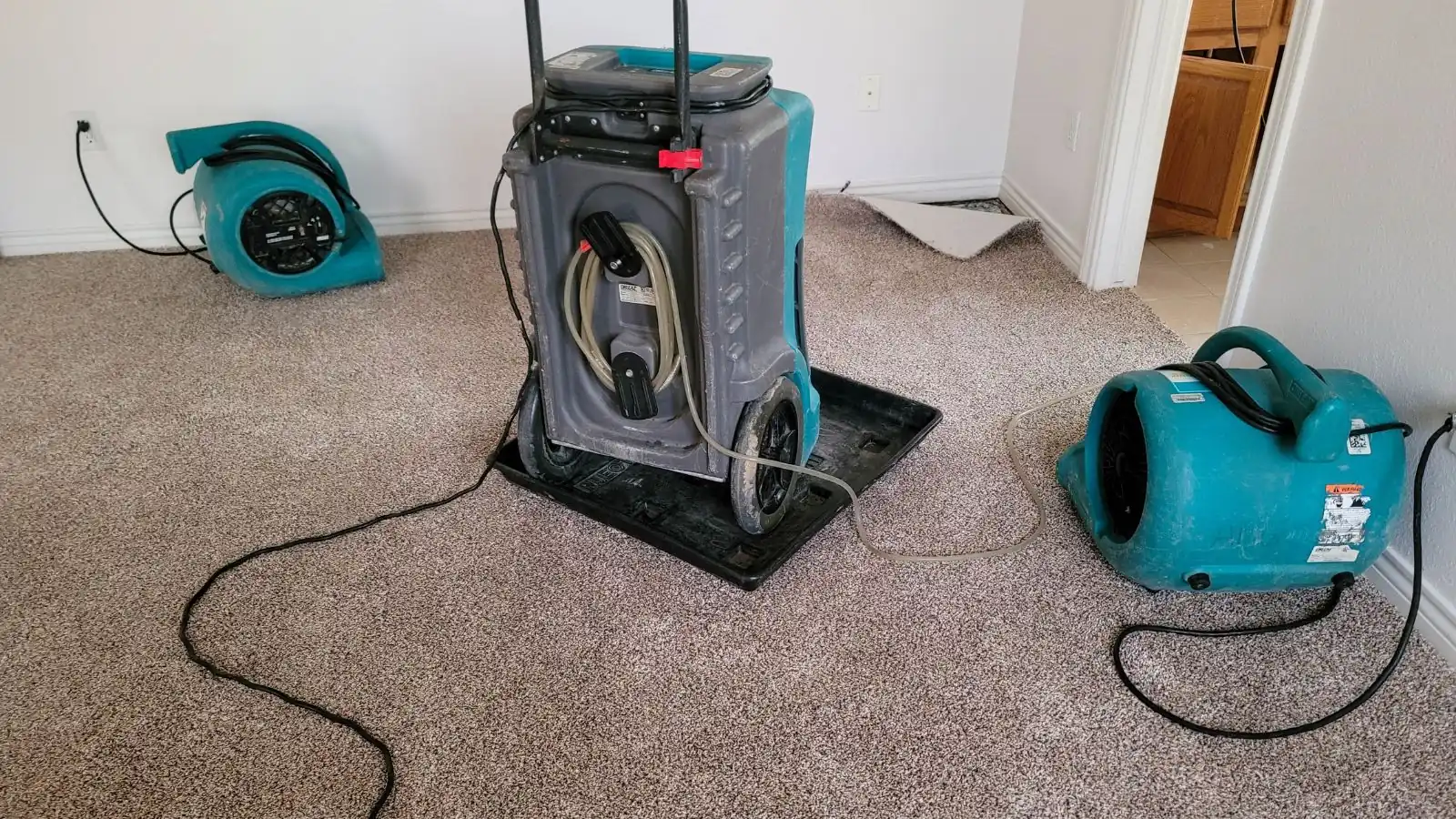
Equipment lists on estimates can look like jargon. The table below translates the main items so you can check that what is on the invoice is actually in your house, running, and sized to the space.
| Equipment | What it does | What to look for |
|---|---|---|
| Moisture meter | Reads moisture inside drywall, wood and subfloor | Readings taken in the same spots on each visit |
| Thermal imaging camera | Shows temperature patterns that point to hidden wet areas | Used to find moisture, then confirmed with a meter |
| Air movers | Push air across wet surfaces to speed evaporation | Placed along walls and under cabinets, not just aimed at the middle of the room |
| LGR dehumidifier | Pulls vapor out of the air so materials keep releasing moisture | Running with doors and windows closed, with a drain line or collection plan |
| Extraction unit | Removes standing and pooled water from floors and carpet | Used first, before any drying starts |
| HEPA air scrubber | Filters airborne dust and debris during demolition | Common when materials are cut out or contamination is suspected |
Notice that the dehumidifier and the air movers work as a pair. Fans alone move wet air around the house, and a dehumidifier alone leaves wet materials with nothing pushing moisture off them.
Moisture readings and the drying log
The drying log is the single best way to judge a company. It is a running record of what was measured, where and when, and it is the reason a crew can tell you honestly that a wall is dry instead of guessing.
A useful log has a few things in it:
- A reference reading from an unaffected area of the same material, so everyone knows what dry looks like in your home
- Daily readings at marked locations on walls, floors and subfloor
- Temperature and humidity readings for the air in the drying space
- A note of every piece of equipment placed, moved or removed
Ask to see the numbers on every visit. If readings are flat for two days, a good crew changes something, such as adding air movers or opening a wall cavity, rather than waiting and hoping.
Equipment should leave only when the readings reach the target for each material. A company that pulls machines because three days have passed is following a calendar, not your house.
How long drying takes
Anyone who promises an exact number of days before seeing the job is guessing. Drying time varies with the materials, the water category, how long the water sat and how much of the structure is wet. Plan on days, not hours, and expect the crew to give you a range that updates as the readings come in.
Material
Hardwood, plaster and thick framing hold water far longer than carpet or thin drywall.
Water category
Contaminated water often means porous materials come out rather than being dried, which changes the whole job.
Time before response
EPA advises drying water-damaged areas and items within 24 to 48 hours to prevent mold growth, so waiting a weekend matters.
Hidden moisture
Wet insulation or subfloor behind finished surfaces can stretch the job even when the visible area looks dry.
If you are comparing bids, ask each company what readings would tell them the job is finished. The answers reveal who is working from a standard and who is working from habit.
Questions to ask before you sign
Put these to every company, and write down the answers. A confident crew will not mind being asked. If you also have a mold concern after a loss, our mold remediation team can explain where drying ends and remediation begins.
- Do your crews work to ANSI/IICRC S500, the published standard for water damage restoration?
- What category of water do you think this is, and why?
- Will you explain scope and price before work starts, in writing?
- What equipment will you place, and how will you decide when to remove it?
- Will I get a copy of the moisture readings and the drying log?
- Who is on site each day, and who do I call if something changes?
- What happens if the readings show hidden damage?
- Are you licensed and insured?
Talk to a crew before you decide
Call (385) 988-9410 and ask how we document drying. Same-day response when available.
Red flags on the estimate and on the job site
Water damage brings out some bad habits in the trade, mostly because homeowners are stressed and in a hurry. These are the patterns to watch for.
No meter in sight
If no one measures anything, there is no way to know when the job is done.
Pressure to sign immediately
A reasonable company explains scope and price first and lets you read it.
One flat price for any house
A price quoted over the phone for a job nobody has seen is a number with nothing behind it.
Equipment that never moves
Air movers and dehumidifiers should be repositioned as the wet areas shrink.
Also be wary of anyone who says insurance will certainly pay for everything. Sudden and accidental water damage is often covered, while gradual leaks usually are not, so check your policy and ask your insurer directly.
Draper conditions that change how drying works
On August 3, 2023, monsoon storms led Draper's mayor to declare a state of emergency, with a little over 2 inches of rain reported in an hour and homes flooded with mud and debris. Water like that is not clean supply water, so a drying company should tell you early whether it is treating the job as contaminated and which materials will likely be removed rather than dried.
Standard homeowners and renters policies do not cover flood losses, according to the Utah Insurance Department, and flood coverage must be bought separately with a 30 day standard waiting period. If the water came from outside, read your policy before you approve a scope, and ask your insurer how it classifies the loss.
If the work involves cutting out and rebuilding walls or floors, Draper runs permits through an online portal, and the city page does not say when one is required. Ask the city before demolition starts, and ask your contractor who handles the paperwork. You can also see how we handle nearby jobs on our Sandy and South Jordan pages.
Sources: Deseret News: state of emergency after Utah thunderstorm, Utah Insurance Department flood FAQ, Draper City permits and applications
Common questions
Do I need a drying company if the water was only a small leak?
Not always, but a small leak can still wet drywall, baseboards and subfloor out of sight. A moisture meter reading tells you whether the area is dry or only looks dry. If you cannot get readings yourself, a short visit is cheaper than rebuilding after mold shows up.
Why do companies run dehumidifiers with the windows closed?
The dehumidifier works by pulling vapor out of the air, and open windows keep feeding it new humid air. Closed doors and windows let the equipment lower the humidity so wet materials keep releasing moisture. It also keeps the noise and heat inside the room being dried.
Can I dry a wet basement carpet myself with fans?
For a small clean water spill caught right away, box fans and a household dehumidifier can help. Carpet pad, tack strips and the wall bottoms still hold moisture that fans cannot reach. If the area is larger than a closet or the water was not clean, call a crew.
How does Draper's storm history affect a drying job?
After heavy rain and mud events like August 2023, water often carries soil and debris into a home. That usually moves the job out of the clean water category, so more porous materials may need to be removed. Ask the company how it classifies the water before you agree to a scope.