
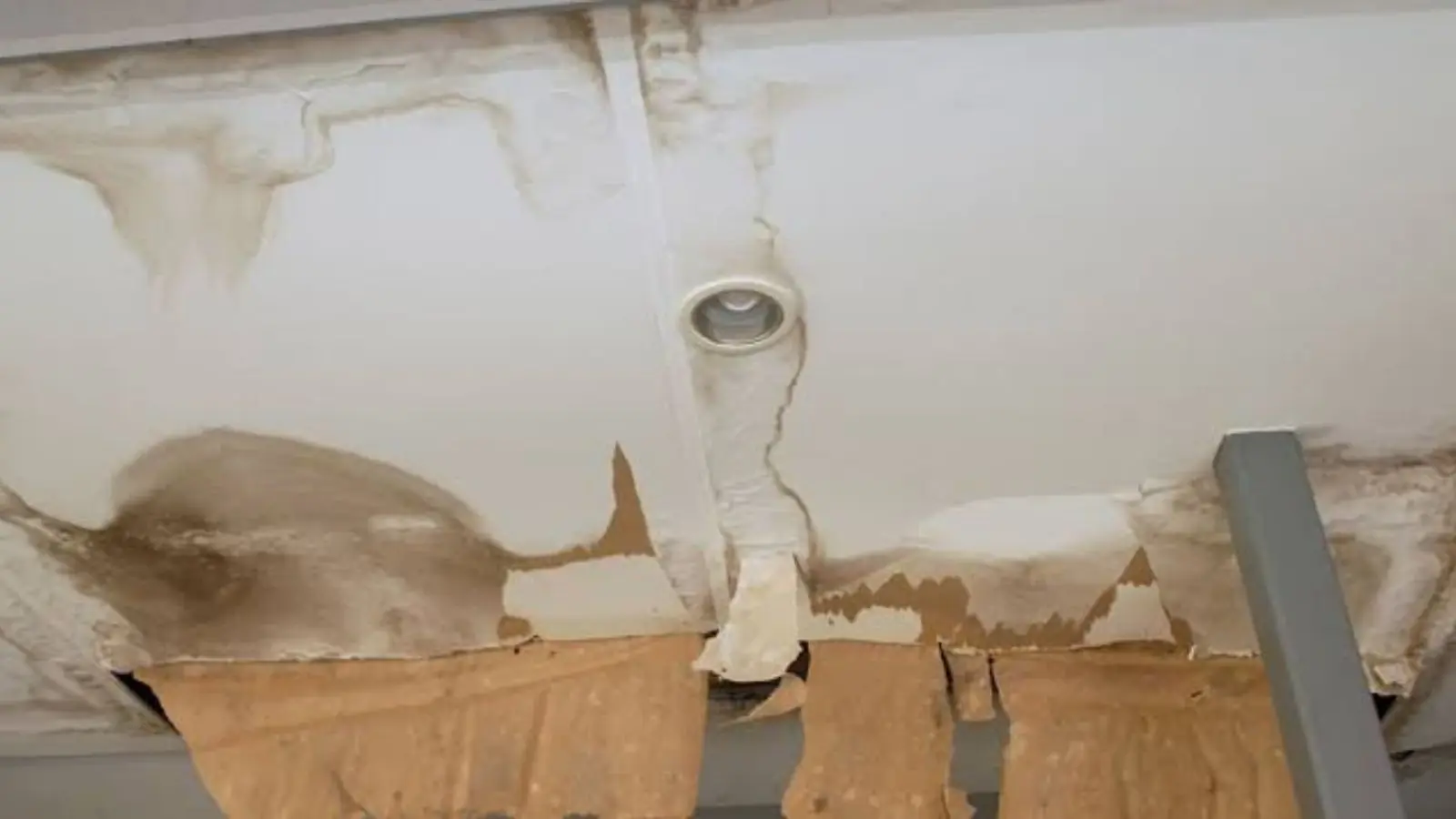
Read the stain before you touch anything
The ceiling is a record of what the water has been doing. Before you grab a ladder, look at the marks and match them to this table, because the pattern tells you whether the leak is active, repeating, or over.
| What you see | What it usually means | Your first move |
|---|---|---|
| One brown ring with a darker edge | A single wetting that has dried, or a slow leak that stopped | Mark the edge with pencil and date it, then check again after the next shower or rain |
| Several rings, one inside another | Repeated wetting from a leak that comes and goes | Look for a source that only runs sometimes, like a toilet seal or roof flashing |
| Tan or yellow patch with no sharp edge | Moisture that soaked in slowly, often from condensation or a seeping joint | Check the HVAC condensate line and any pipe above the spot |
| Bubbling or peeling paint | Water trapped behind the paint film | Keep hands off, since popping it can pull the paper off the drywall |
| Soft, sagging, or bulging drywall | Water pooling on the top side of the sheet | Treat as urgent and follow the first-hour steps below |
| Active drip | A leak that is running right now | Stop the water if you can, catch the drip, and keep people out from under it |
| Dark specks or fuzzy spots | Moisture present long enough for growth | Do not wipe or paint, and see the mold guidance on this site |
Rings that darken after a shower point toward plumbing. Rings that appear after a storm or snowmelt point toward the roof. A ring that grows only when the air conditioner runs points toward condensation.
Match the location to the likely source
Where the stain sits is the second clue. Four sources account for most ceiling leaks in two-story and finished-basement homes.
Roof and attic
Stains near an exterior wall, a chimney, a vent pipe, or a valley in the roof line. Look for wet, dark insulation and daylight around flashing.
Bathroom or kitchen above
A stain under an upstairs bath or a first-floor kitchen, often near a tub, toilet, or dishwasher. Common culprits are a failed toilet seal, a worn tub drain, or a cracked supply line.
Supply and drain lines in the joists
A stain in the middle of a hallway or basement ceiling with no fixture overhead. A pinhole in a copper line or a loose fitting can drip for weeks.
HVAC condensate
A stain below an attic air handler or furnace. The condensate pan overflows when the drain line clogs with slime, and it usually happens in the cooling season.
Trace it in about twenty minutes
You do not need tools beyond a flashlight to narrow it down. Work through these in order and stop when you find water.
- Go to the room directly above the stain and look for damp flooring, a soft spot near the tub, or a wet cabinet floor.
- Run one fixture at a time (sink, shower, toilet flush, dishwasher) for a few minutes each, and watch the ceiling or a helper's report between runs.
- Check the attic with a flashlight, stepping only on joists. Look for dark, compressed insulation and drips on wood.
- Find the air handler and look at the condensate pan and drain line. Standing water or a line that is not draining is the answer.
- Turn off every water use in the house and read your water meter. If the dial keeps moving, there is a leak somewhere in the supply system.
- If you still cannot find it, a moisture meter and thermal imaging camera can map wet areas without opening anything.
If the leak only appears during rain or snowmelt, the source is outside the plumbing. Take photos of the attic from the hatch and send them to a roofer along with the date of the last storm.
The first hour: what to do and what to leave alone
Start with safety, then stop the water, then limit the damage. Water and electricity are the real danger in a wet ceiling, so everything below depends on what is in or near the wet area.
Stop the source
If a fixture or appliance is the cause, close its shutoff valve. If you cannot tell, shut the main water valve to the house.
Check for electrical hazards
If a light fixture, ceiling fan, or outlet is under or beside the wet spot, do not stand under it. If you can reach your panel safely and dry, turn off the breaker for that room.
Catch the drip
Set a bucket under the drip, with a tarp or towels beneath it. Move furniture and rugs away from the area.
Relieve a bulging ceiling only if it is safe
A drywall bulge full of water can collapse. If it is away from any light, fan, wire, or vent, you can poke a small hole at the lowest point with a screwdriver on a long handle, standing to the side with eye protection and a bucket below. If it is near electrical or you are unsure, stay out of the room and call.
Document first
Take photos and a short video before cleanup. You will want them for any insurance conversation.
Do not push up on a sagging ceiling, do not use a shop vacuum on wet drywall dust overhead, and do not turn on a ceiling fan to dry it.
Emergency, urgent, or can it wait
Call right away
- Water is dripping through a light fixture or fan
- The ceiling is bulging, sagging, or has started to crack
- The water is dark, smells like sewage, or came from a toilet or drain
- The drip is steady and you cannot find a shutoff
Same-day or next-day call
- A stain is spreading but there is no active drip
- Insulation above is wet
- The ceiling has stayed damp for more than a day
Can usually wait for a repair quote
- A dry, stable ring with no growth, after a source that has been fixed and confirmed
If you are somewhere in between, a call costs nothing and a wet ceiling gets worse fast. Standing water and damp drywall may start to grow mold within 24 to 48 hours, according to EPA guidance.
What a professional diagnosis adds
A restoration crew starts by finding where the water went, not just where you can see it. Moisture meters, thermal imaging, and an attic walk-through usually show that the wet area is bigger than the stain, which changes how drying is done under water mitigation.
Once the ceiling is dry and the source is fixed, the cosmetic work falls under water damage repair. Homeowners in Riverton and Herriman can call the same number to describe the stain and get routed to the right step.
Not sure where the water is coming from?
Call (385) 988-9410 and describe the stain, its location, and when it appears. We will tell you whether to wait or send a crew.
Draper note: storm bursts and roofs
On August 3, 2023, Draper's mayor declared a state of emergency after a little over 2 inches of rain fell in just over an hour. Short, heavy bursts like that are when a marginal roof flashing or a clogged valley starts letting water into the attic. If a ceiling stain appears the same day as a monsoon storm, get into the attic that evening and look for wet insulation, because the stain on the ceiling usually lags the leak.
Keep the problems separate. The city lists an after-hours emergency line for storm water issues, but that is for streets and drainage, not for the inside of your house. A dripping ceiling is a call to a restoration company or a roofer, and a flooded street or yard is a call to the city.
Sources: Deseret News: state of emergency in Draper after August 3, 2023 storm, Draper City: water and storm water, EPA: brief guide to mold, moisture and your home
Common questions
Is a brown ring on my ceiling always an active leak?
No. A ring can be left behind by a leak that has already stopped. Mark the edge in pencil with the date, then watch it after the next shower or rainfall. If the ring grows or the paint is soft, the leak is still going.
Can a ceiling leak come from the air conditioner?
Yes. An attic air handler has a condensate pan and drain line, and when the line clogs the pan can overflow onto the ceiling below. The stain tends to appear in warm months and may be a pale tan patch rather than a dark ring.
Should I poke a hole in a bulging ceiling?
Only if it is safe. The bulge needs to be away from light fixtures, fans, wiring, and vents, nobody should be underneath, and a bucket must be ready. If any electrical is nearby or you are unsure, stay out of the room and call for help.
How fast does drywall have to be dried?
EPA guidance says to dry water-damaged areas and items within 24 to 48 hours to prevent mold growth. Wet drywall and insulation above a ceiling are hard to dry without equipment, so waiting is a gamble.
A summer storm hit Draper and now my ceiling has a stain. What should I check?
Go to the attic as soon as it is safe and look for wet insulation under the roof, especially around vent pipes, chimneys, and the roof valleys. Take photos for a roofer and your insurer. Heavy short-duration rain, like the August 3, 2023 storm, can find weak flashing quickly.